Lesson 8 – Chord Progression Practice
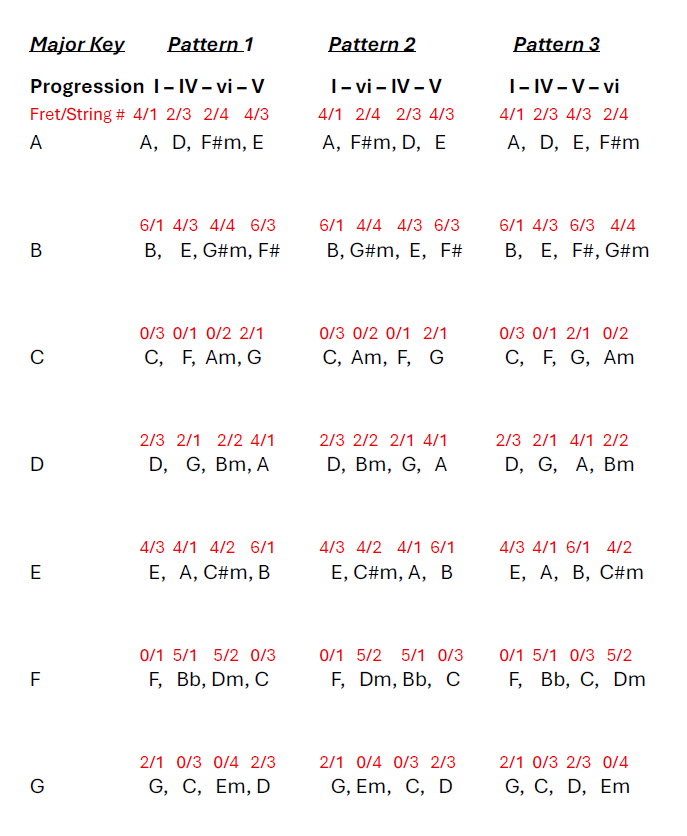
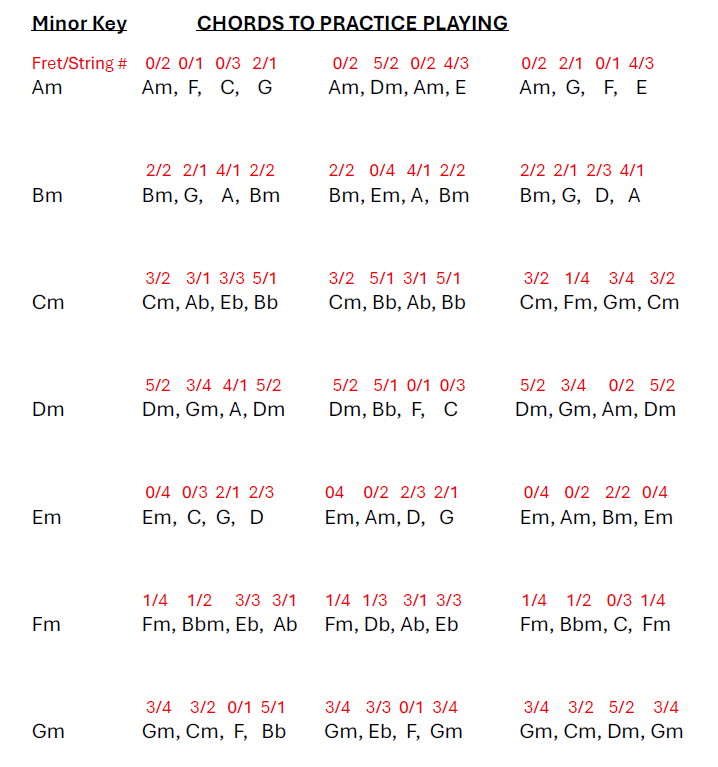
Time to start practicing a few simple Chord Progressions. Chord Progressions are chords in the same Key that sound good together. The Chord Progression listed below, in the MAJOR Keys, is a popular … I – IV – V … Progression with a Minor vi chord placed in different positions. I’ve also included a mix of Chord Progressions in the MINOR Keys..
Note : All Major chords start on either the “F” or “C” strings … and all Minor chords start on either the “A” or “E” strings!
Practice each four-chord progression … SLOWLY, at first! A lowercase “m” beside a Chord means the chord is a Minor chord (Dm = D-Minor, Am = A-Minor, etc.). Flats have a lowercase “b” beside the chord name (Bb = B-Flat Major) while sharps have a “#” beside the chord name (F# = F-Sharp Major). This is a F-Sharp Minor F#m.
Start off strumming each of the four chords in the progressions two or three times each. Begin with the first chord in the progression and work your way down to the last chord in the progression, then back up to the first chord again. Practice each progression in every Key. Once you start feeling comfortable, change up your timing. Try strumming the chords differently, maybe try … down, pause, down, down, pause. Then, try … down, down, pause, down, down, pause, down, pause. Be creative … make up your own strumming patterns … play whatever sounds good!
CHORD PROGRESSIONS TO PRACTICE … To make things much easier, I’ve included both the FRET number and the STRING number above each chord … “O” indicates an Open Chord! Example: To play a C-Major chord … “0/3” indicates that an “open” chord is to be played, starting on string “3”, the third string down ; to play an F#-Minor chord … “2/4” indicates that the chord is to be played using fret “2”, starting on string “4”; etc.